Showing posts with label Daily Telegraph. Show all posts

Sunday, June 2, 2013

Like her French, Camilla's visit was 'formidable'

The Duchess truly charmed us on her first solo trip abroad, says Anne-Elisabeth Moutet
 
Camilla, Duchess of Cornwall (R) listens to explanations by a Louvre staff member as she visits the Louvre Museum on May 28, 2013 in Paris
A member of staff shows the Duchess of Cornwall around the Louvre Museum Photo: AFP/GETTY
There was something delightfully pre-celebrity about the Duchess of Cornwall’s visit to Paris last week. For one thing, most of us knew nothing about it. Nice middle-aged English lady takes train; goes to charity shop; has a slice or two of saucisson in the Boulevard Raspail street market; nips into Dior to be shown fairy-tale size-zero dresses into which neither she nor any of her entourage has a hope of fitting; takes in the Mona Lisa at the Louvre; looks at horses; and rounds up proceedings with a drinks do at the British Embassy and a cosy dinner with friends. This is firmly Don’t Tell Alfred territory, belonging in those earlier times when France was a kind of sunny hinterland for Mitford sisters of the not-enough-married (Nancy) or too-married (Diana, Lady Mosley) variety.

Non-Royal reporters here in France (that’s everyone except Paris Match and Gala) remained in blissful oblivion of this event: the first solo visit by the future British Queen abroad. Camilla – we call her just “Camilla”, just as France Soir in its 1960s heyday chronicled the ups and downs of “Tony et Margaret” (Lord Snowdon and Princess Margaret) – hopped off her Eurostar at Gare du Nord with very little fracas, and with her pared-down entourage, went largely unremarked in the streets until she was called upon to perform.

She sent off a bike expedition for Help for Heroes from the grand courtyard of the Invalides, and made a short speech in excellent but accented French at the Communauté d’Emmaüs at Bougival, West Paris. Like her mother-in-law, although perhaps more approachably, she showed perfect, smiling courtesy throughout. But you could tell she really felt in her element with the Garde Républicaine horses, their riders, even their farriers. (How many Gardes Républicains does it take to shoe a horse? Three – one to hold the horse, one to hammer the red-hot shoe, one to speak to Camilla, carefully omitting that Napoleon is buried next door.)

The visit couldn’t have been better calibrated to French sensibilities. Emmaüs UK, the charity of which the Duchess is a patron, is a 1990s-created offshoot of perhaps France’s best-loved movement, founded in the immediate post-war years by a Catholic priest and former Resistance member from Lyon, Abbé Pierre, who relinquished his MP seat to take up the defence of the homeless in a country still scarred by the war and under rationing edicts. Until his death in 2007, Abbé Pierre regularly polled at the top of a list of France’s most-liked personalities. Emmaüs, which concentrates on giving the destitute a place to live and to work, is a kind of French Oxfam, with low overheads: no glittering fundraisers or expensive headquarters.

As the Duchess visited one of the Emmaüs thrift shops, the British ambassador, Sir Peter Ricketts, made a point of buying her a pretty, rectangular Cartier-lookalike watch, a snip at 10 euros. This was no Chinese fake, but bore the name of the defunct Lip watchmakers, France’s only would-be workers’ commune back in the 1970s. If intended, this was an elegant historical reference and a dream diplomatic gesture, appreciated by anyone in François Hollande’s Socialist government: a Lip watch bought at Emmaüs is worth 10,000 social- conscience cred points.

In short, in terms of easing the Duchess into her next big part, you could say the visit was a real low-key success. The French, like the rest of the world, had happily gone Diana-mad in the 1980s and 1990s. Following Charles and Diana’s state visit to Paris for this newspaper in 1988, I well recall the crowds, the press photographers in their dozens, the breathless segments opening the evening news. We got Diana at the Elysée with François Mitterrand, and Diana at the Hôtel de Ville with Mayor Chirac (a presidential hopeful at the time, he was very keen on the reflected glamour), and the reception at Versailles with former president Giscard d’Estaing (who would much later write a rather silly self-insertion roman à clef in which he had an affair with the princess). It was all about the bling.

Last week’s Paris trip was pretty much the exact opposite of that (no novels in the offing, I suspect), so much in fact that no one even thought of bringing up comparisons. Characteristically, when she posed in front of the Mona Lisa at the Louvre, the Duchess made sure that she wasn’t obscuring Leonardo’s picture on the photographs (“Can’t have that!”) – this wasn’t going to be a Taj Mahal photo-op.

When Sidney Toledano, the CEO of Dior – and the man who personally fired the most famous Briton in French fashion, John Galliano, two years ago – showed Camilla around the present-day ateliers and the New Look frocks of the Dior museum, nobody mentioned that Dior had named a handbag after Diana (her ubiquitous Lady D quilted bag). Instead, everyone made much of the Duchess’s charming second-hand raffia clutch, a novelty item with no pretensions to It-ness, embroidered with the word “Paris”.

Nor did French fashion writers make anything of her Anna Valentine outfits – although the online comments sections weren’t always as charitable: a floaty printed dress worn with a sharply-tailored mustard jacket passed muster; so did a classic Burberry trenchcoat; the dowdyish coat-dresses (“housecoats!”) didn’t.

This didn’t matter. In today’s depressed climate, France is nursing what feels like the mother of all Eurozone hangovers: right now, the nation can take neither overbearing First Girlfriends with a waspish line in tweets, nor size-zero princesses in 5in nude heels and look-at-me clothes. The French are notorious for being coldly, elegantly uncomfortable, but right now they are atypically amenable to a bit of cosiness – and Camilla looked cosy all right, especially as she didn’t really need a refashioned image in the first place.

We are tolerant of affaires de coeur. We never really held Charles’s infidelity against him to begin with. In fact, one of Gérard Depardieu’s best movies, Bertrand Blier’s award-winning Trop Belle Pour Toi (1989), described a rather similar set-up, with the Depardieu character neglecting his high-maintenance, beautiful wife, the former Bond girl Carole Bouquet, for the homely but warm Josiane Balasko. We gave it a slew of Césars (the French Oscars) and the Prix Spécial du Jury at Cannes.

With no monarchy in our own country, the French like kings and queens abroad. And while we require a great deal of majesty from our presidents – the Fifth Republic, after all, was tailored to Charles de Gaulle’s specifications; it’s one of François Hollande’s many political mistakes that he described himself as the “normal” president – we prefer, all things considered, the more relaxed type in neighbouring nations.

The one reigning French citizen is the Prince Consort of Denmark, Henri de Laborde de Monpezat, husband to Queen Margrethe, and for years the Danish royal couple have spent family holidays in South-West France with minimum fuss. The French see the Queen herself as a grandmother and an animal lover (yes, we do like animals: one of the longest-running television programmes here is a much-loved show on pets called 30 Millions d’Amis), as well as a kind of monument. An extraordinary constant over the years.

On present form, Camilla seems well placed to ease herself, almost by stealth, into solid monumenthood.

Friday, May 27, 2011

Christine Lagarde: the Coco Chanel of world finance could save Sarko

If France’s finance minister gets the IMF job, her boss will be Europe's happiest man, says Anne-Elisabeth Moutet.
Christine Lagarde: the Coco Chanel of world finance could save Sarko; French Minister Christine Lagarde in Paris, 2009; Sipa Press
French Minister Christine Lagarde in Paris, 2009 Photo: Sipa Press

It would be impossible to overestimate the depth of the embarrassment the French feel about Dominique Strauss-Kahn’s spectacularly sleazy fall from grace. Yet the nation is agog at the prospect of a largely unhoped-for consolation prize: the appointment of Christine Lagarde, currently France’s finance minister, to replace him as managing director of the International Monetary Fund.

Lagarde seems to be the woman without enemies. She is supported by an unlikely alliance of her German counterpart, Wolfgang Schaüble, and Britain’s George Osborne, who doubtless admires her passion for Hayekian economics. Despite their reservations about a European stitch-up, the Brazilians and Chinese seem to be warming to her. The opposition Socialists have, after praising her fine qualities, decided to oppose her candidacy, but have been seen as bungling and unpatriotic for doing so.

All this is quite a triumph for a near-unknown, who spent her entire career in one of America’s largest law firms, and only took a junior cabinet post in 2005 – and for Nicolas Sarkozy, the man who four years ago made her the first female finance minister in the entire G8. Yet Lagarde has a track record of terrifying competence. The elegant 55-year-old (still a size eight) is trilingual in French, English and Spanish. A former scholarship student, champion synchronised swimmer and scout troop leader, she joined the firm of Baker-McKenzie straight out of law school, rising to become its chairman before jumping ship to enter politics.

Part of the secret of Lagarde’s success is that she maintains complete control over her image. She has been married twice, before settling down with an old friend from university whom she met again six years ago. But neither of her former husbands – the mysterious M. Lagarde, who fathered her two sons, or Eacran Gilmour, nationality uncertain, who runs companies in Poland – is even mentioned in her official biography or Who’s Who listing.

She is also a first-rate television performer, capable of showing up for an interview with the US comic Jon Stewart wearing a Gallic beret and play-acting the caricature Frenchman. It is possible she made the outfit herself – she has been known to run up smart dresses on her mother’s old sewing machine – but generally, she favours severe Armani and Chanel suits, Hermès handbags and discreet scarves. In doing so, she embodies a distinctive chic miles away from the bling of the early Sarkozy presidency, which has made her a regular in the pages of the glossy magazines.

Her focus, though, has always been on her work: even the supercilious énarques, France’s civil service mandarins, value her. In addition to her competence, explains one Elysée aide, she always deals with challenges or feuds herself, never asking for support from the president (in contrast to all too many of France’s political divas). “She is the least heavy-maintenance in the entire cabinet,” he gushes.

Although she has few enemies, those who have crossed Lagarde share the shell-shocked look of someone who has been hit by a semi-articulated lorry. Her junior minister for foreign trade – a job she had herself held – found himself shorn of most of his sensitive work soon after Lagarde decided he was a lightweight. “She’s always smiling, always polite, but she’s an American lawyer at heart – a killer shark,” says a former Ministry of Finance official, who was fired for not showing up at her job enough, even though she is one of Lagarde’s party and sits with her in the Paris City Council. “You don’t do this to a fellow councilwoman, let alone someone of your own party.”

Outside of France, Lagarde is known as a networker among the world’s most powerful women, championing quiet affirmative action “when needed” to break the glass ceiling. She has been called the “rock star” of international finance, but she’s more the Coco Chanel, preferring to build consensus and reach elegant solutions to testosterone-fuelled posturing. (Famously, she said that if Lehman Brothers had been called Lehman Sisters, it might not have imploded.)

It is, however, that preference for arbitration over conflict that could derail her IMF candidacy. As finance minister, Lagarde put an end to a legal battle over the near-collapse of Crédit Lyonnais in the 1990s – but France’s official Court of Audits has now indicated that the plaintiff received too much in compensation, and questioned Lagarde’s decision to overrule her bureaucrats. Piquantly, they will announce whether a judicial case will result on June 10, the very day when the IMF will name its next boss. Still, do the magistrates really want to dash France’s hope of saving the IMF job for La Patrie?

If they decide against a court case, and Lagarde does get the job, then Nicolas Sarkozy will doubtless contemplate the turn in his fortunes with glee. Ten days ago, his poll numbers were burning holes in the Elysée carpets. Now his most dangerous presidential competitor is facing a long term in jail; the Socialists are about to tear themselves to pieces in a take-no-prisoners primary; his wife is awaiting the birth of a son and receiving rave reviews for her “luminous” performance in Woody Allen’s new film Paris at Midnight; and he has even come across as lovable in La Conquête, a The Deal-style biopic about his 2007 election campaign. As everyone, even Les Rosbifs, lines up to back his finance minister to blaze a feminist trail at the world’s financial watchdog, Le Président must be feeling that there is a God after all.

© Copyright Telegraph Media Group & Anne-Elisabeth Moutet 2011

Monday, May 16, 2011

Dominique Strauss-Kahn: A Frenchman sunk by a sex scandal?

If the allegations against Dominique Strauss-Kahn end the popular IMF chief's presidential candidacy, it would be a first for France, writes Anne-Elisabeth Moutet in Paris.

Dominique Strauss-Kahn: IMF head accused of sexually attacking a hotel chambermaid
Dominique Strauss-Kahn to appear in New York court over alleged sex attack on hotel maid Photo: AFP/GETTY

IMF chief Dominique Strauss-Kahn’s likely candidacy – and probable victory – next year against Nicolas Sarkozy in the French presidential elections (he had been leading by double digits in every poll in recent months, even without declaring himself officially) should have ushered in a series of firsts for France’s political life. First French Socialist leader to have officially discounted Marxism; first Jew directly elected to the presidency; and first seriously rich president in a country where money, not sex, is a dirty word.

Instead, DSK, as he is known here, will go down in history as the first French politician whose career imploded because of a sex scandal, not a financial one. When the news broke in Paris early yesterday that France’s former finance minister had been arrested by the New York police for alleged sexual assault on a hotel housekeeper, reactions here were split between sheer disbelief, suspicions of entrapment and all-too-many knowing shrugs.

“Dominique Strauss-Kahn is well-known as a seducer,” his official biographer, Michel Taubmann, said. “I can’t believe he would force himself on an unwilling woman. That doesn’t make sense.”

Such a statement would come across as damning in most Western countries. In France, it is seen as a spirited defence. Until today, complicated sexual lives, multiple divorces and serial adultery never hampered political careers. François Mitterrand famously ran three parallel families while president. He appointed a former girlfriend of his, Edith Cresson (a married woman) as prime minister in 1991. His predecessor, Valéry Giscard d’Estaing, used to borrow a Ferrari from his friend Roger Vadim, the film director and Brigitte Bardot’s first husband, when he went on the pull. (He once crashed it into a milk float early one morning on his way back to the Elysée.) Jacques Chirac and Nicolas Sarkozy were known for eyeing up comely reporters and female junior ministers.

In that context, DSK’s notorious penchant (and more) for a legion of pretty women did him no harm at all. “If anything,” Taubmann recalls, “he was the one harassed, not the reverse — I’ve seen time and again women MPs, party workers, etc brazenly passing on notes, hoping he would notice them.”

Alleged assault, however, is another matter entirely. “If the whole situation isn’t exposed for being a political set-up in the next 24 to 48 hours,” French leading polling expert Stéphane Rozès warns, “Monsieur Strauss-Kahn’s political career is finished. He is, of course, presumed innocent until proven guilty, but even suspicion of attempted rape will make it impossible for him to stand.”

It is well worth noting that it took the long arm of New York’s finest to make the Strauss-Kahn scandal incontrovertible even to the very cagey French press. With the help of the internet — the great difference with the Mitterrand years, where the average French voter was left ignorant of the president’s natural children, for instance, and stringent privacy laws were supplemented by thousands of illegal phone taps directly commandeered by his private office — all the stories about his womanising have filtered down for years.

What is more surprising is that DSK has also been accused in the past of assault along eerily similar lines, if not as brutal as what the NYPD spokesman has alleged. Journalist and novelist Tristane Banon, a god-daughter of DSK’s second wife Brigitte Guillemette, recalled in a 2007 book, then in a TV chat show that same year, going to interview Strauss-Kahn to an address “he gave me, neither his office nor his flat; an elegantly appointed studio, with a bed in an alcove”, in which, she said, he grabbed her, tore off her bra, and she only managed to escape after a serious scuffle. “I kicked him, I called him a rapist, he didn’t seem to care,” she said. (DSK’s name was bleeped out in the chat show.)

Banon’s mother, Anne Mansouret, a Socialist local politician, confirmed the story yesterday to the respected website Le Post. Banon consulted a barrister, but finally decided not to sue, a decision her mother now regrets having encouraged her to do so. “She was just starting out in journalism,” says Mansouret. “I was afraid she’d be defined by this story.” She says her daughter will give a press conference “in the coming days”.

Other instances may well resurface. Aurélie Filipetti, a respected Socialist MP and Ségolène Royal supporter, said in 2008 that she had been groped by DSK and would “forever make sure” she was never “alone in a room with him”.

And yet nobody among DSK’s spin doctors and advisers seemed to think this would blow up in the face of their candidate. In recent weeks, as the probability of his candidacy looked certain, and politicians and the press made hay of his taking a ride in a Porsche owned by his main adviser, Strauss-Kahn and his wife Anne Sinclair sued France-Soir, a Paris newspaper, for disclosing the benign fact that he had bought three suits from a French bespoke tailor in Washington, who also dressed several US presidents, for a sum estimated “between $7,000 and $35,000 apiece”. Looking rich – he is in his own right and his wife, the granddaughter of one of France’s great art collectors, is even more wealthy – was seen as infinitely more toxic.

On the other side of the divide, Nicolas Sarkozy’s team were rubbing their hands at the prospect of their own man’s taste for bling, Rolex watches and expensive pens being negated by DSK’s own tastes for luxury.

“What are holidays in my wife’s family house on the Mediterranean next to a three million euro riyad in Marakesh?” Sarkozy himself was reported to have said to Cabinet members.

When he was appointed to the IMF in 2007 with the support of Nicolas Sarkozy — who saw a welcome opportunity of ridding himself of a dangerous opponent, at least for a time — most DSK-watchers warned that Dominique, for all his sophistication and razor-sharp intelligence, would do well as head of the world’s economic watchdog, but might not realise the cultural gap between life in Paris and Washington. Sure enough, barely a year later, DSK’s affair with an IMF economist, the Hungarian Piroska Nagy, made international headlines.

Amazingly, he survived that crisis. It probably helped that the disclosures occurred exactly three days after the beginning of the financial meltdown, on October 18, 2008. After an internal inquiry, the IMF published findings that Strauss-Kahn, universally seen as a safe pair of hands in difficult times, had neither favoured his mistress, nor harassed her. Bowing to American mores, DSK apologised publicly to his high-profile wife, something he had never bothered to do before in France, and Ms Nagy soon afterwards took the opportunity of a well-compensated redundancy when DSK decided to bring cost-cutting home to the IMF, and shed 600 top jobs.

In the following years, he burnished his credentials as a hard-working boss, criss-crossing the globe to help bail out failing financial institutions and defaulting countries, all the while avoiding criticism from the Right or the Left — he is one of the stars of the Oscar-winning documentary Inside Job, for instance, in which he details the work done to keep the economic sphere from exploding, and calls for more regulation of financial institutions in moderate, convincing tones.

Unlike most of France’s political elite, but like Nicolas Sarkozy — and Marine Le Pen — Strauss-Kahn is not a civil servant and a graduate of the top government school, ENA. He found himself, as finance minister, constantly sneered at by his supercilious mandarins for what was seen as his “inferior” education, even though he has taught at Stanford and Harvard, and co-authored major economics books. When, between political mandates, he turned to the private sector to make a living, instead of sliding back effortlessly into a well-paid, guaranteed-for-life civil service job, he was derided for a supposed crass love of money. Helping to save the world economy and being constantly voted France’s most popular politician, on track for the presidency no less, was essential recognition at last.

But all this came to a crashing halt on Saturday, as DSK was walked out of the first-class cabin of Air France flight 23 sitting on the tarmac of JFK airport, to be arraigned at the Harlem Special Victims Unit of the NYPD, and subsequently charged with “attempted rape, [a] criminal sexual act, and unlawful imprisonment”.

The French presidential race is wide open again, as DSK’s closest contender in the Socialist primaries, the lacklustre François Hollande, and Nicolas Sarkozy refrain from commenting for fear of appearing too eager to take advantage of their rival’s meltdown.

The only untroubled beneficiary is the Front National’s Marine Le Pen. “I am utterly unsurprised,” she said yesterday. “He must be presumed innocent - but everyone in the Paris political village knew of Dominique Strauss-Kahn’s pathological relations with women.”

© Copyright Telegraph Media Group & Anne-Elisabeth Moutet 2011

Friday, May 13, 2011

Forget the Oscars, the Cannes critics are the best in the world

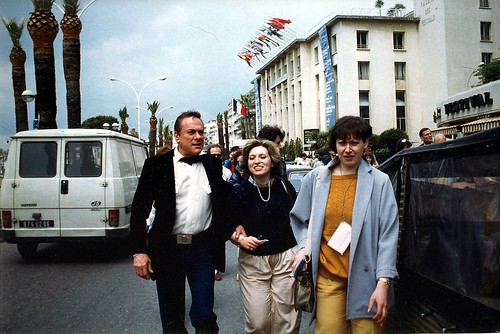
Tony Curtis & Anne-Elisabeth Moutet, Cannes Film Festival, 1985

France's film critics are the country's gift to world cinema. And at the Cannes Film Festival, they have their time in the spotlight, says Anne-Elisabeth Moutet.

8:17PM BST 13 May 2011

If it's May on the Riviera, it must be time for the Cannes Film Festival – and for another whine about how commercial everything has become. How could a festival meant to celebrate the art of cinema sell its soul to Hollywood's increasingly over-inflated blockbusters?

Rather than parading up and down the Croisette, getting photographed on the beach in skimpy bikinis, and generally doing the right thing by their fans, stars and jury members remain incarcerated in a soulless concrete bunker that looks and feels like the venue for a trade fair (which it is for the other 350 days of the year). Once inside, they're protected by a phalanx of press officers, a regiment of Navy Seals, and stricter retinal scans and background checks than for marrying into the Royal family.

Why do the French put up with it? Why demonstrate an entirely atypical flair for crass commerce by superimposing on to the main event – as well as elevated competitions like Semaine de la Critique – the Cannes Film Market, a roaring convention taking up the cavernous basement of the Palais des Festivals, where hawkers from around the globe will cheerfully sell you the rights to direct-to-video gems such as Combat Girls, Turn me on, Goddammit and The Godfathers of Ganja?

The answer is simple. Yes, Cannes might be a bit tasteless. But for the French, the whole affair still preserves the ultimate in filmic fiction: that it's our opinion that matters. Sure, we might not have been able to sell any of our television series between Inspector Gadget and Spiral. Sure, our last Oscar-winner may have been March of the Penguins. But by Guillaume, we're going to be the arbiters of cool in all things cinema. To that end, we happily bring the world's biggest stars to Cannes to run the gauntlet of a gang of critics wielding Derrida like a semi-automatic, and slather it in enough Gallic glamour to make Oscar night look like The Sarah-Jane Adventures.

There is none of that nonsense that afflicts the Oscars about voting by members of the Academy: the process of jury selection, as well as the ultimate choice of competing entries, is shrouded in opacity. Gilles Jacob, the president-for-life of the festival committee, has even, in Hosni Mubarak fashion, appointed his son to the four-person body that picks the 12 foreign entries in the Sélection Officielle from some 4,000 hopefuls.

The actual jury, picked with a canny eye for the best mix of star power and intellectual cred, changes every year. This time round, it includes Uma Thurman, Robert De Niro (as the chair), "Norwegian critic Linn Ullmann", as well as directors from France, China, Chad, an Argentinian "producer-actress", a Chinese producer, and Jude Law.

If this seems to be taking inclusiveness slightly too far, it is entirely intended. After the post-war years, when the French government supported the Festival as a way to rebuild the country's film industry, it gradually evolved into the magical meeting place of the movie world: Hollywood, Cinecittà, Ealing. And when François Truffaut deservedly snatched the Palme d'Or in 1959 for The 400 Blows, he and his fellow Cahiers du Cinéma critics turned Nouvelle Vague auteurs provided France with a cachet on which we have been trading ever since.

France has, admittedly, always been the best place in the world to see films. In those remote times before VHS, the 500-plus arthouses of Paris far exceeded in number and variety the choices available in New York, let alone the wastelands of London. After school, I picked up an invaluable crash course in the film culture of the past 70 years, ranging from Glauber Rocha to D W Griffith, from Billy Wilder to Antonioni, from John Ford to Karel Reisz, from Busby Berkeley to Ingmar Bergman.

And at the end of the day, the Cahiers crowd did make sense with their auteur theory, which maintains that a director is, in fact, the author of a unique work, not a hack standing behind the camera shouting directions. They were right about the distinctiveness of a film directed by Fritz Lang, Hitchcock, Ophüls, Carné or Visconti. (They also had a sort of point about Jerry Lewis – it was, in a way, unique in its sheer godawfulness.)

Perhaps, then, our critics, as much as our films, are our gift to world cinema. The history of the Nouvelle Vague is largely one of backseat drivers who turned filmmakers, with a sometimes astonishing degree of success. When a fanboy named Steven Spielberg cast Truffaut in Close Encounters of the Third Kind, he was acknowledging an intellectual ascendancy which the French have been careful to perpetuate.

It was we, too, who were the first to lionise Clint Eastwood as an auteur in the 1980s. The process was masterminded by a single, not particularly successful journalist, Pierre Rissient, who decided to remake this B-movie star into a cultural icon. (He also championed Quentin Tarantino, as well as Aki Kaurismäki, proof of his singular eye.)

So yes, we French can be infuriating. But every now and then, we get it right.

© Copyright Telegraph Media Group & Anne-Elisabeth Moutet 2011

Thursday, April 7, 2011

Sarkozy’s six wars will make or break him

The French president has public support, but if things go wrong that will fast disappear, says Anne-Elisabeth Moutet.

Libya: Sarkozy and Gadaffi before they fell out
Mr Sarkozy once enjoyed a cordial relationship with Col Gaddafi Photo: AFP/GETTY

Not even George W Bush could have hoped to get away with six simultaneous wars. Yet Nicolas Sarkozy seems to be thriving on them. We French have troops in Mali, Afghanistan, Burkina Faso, Somalia – and, most visibly, over Libya and in Ivory Coast.

Cynics will argue that Sarkozy is a gambler, staking his re-election next year on the throw of the military dice. But even though he’s wildly unpopular, and a political calculator nonpareil, the truth is that Sarko is also showing his own peculiar brand of sincerity. He genuinely believes, for instance, that France’s failure to stop the Rwandan genocide was dishonourable (as a junior minister, he argued in favour of intervention). And he has form: a couple of years ago, he authorised a raid against Somali pirates, resulting in the rescue of our hostages and the pirates being showily taken back to France for trial.

Any image of the French as pacifists is misleading. We hate losing wars, but we believe in both la gloire and in hard-nosed choices that we sell to ourselves as idealism. We have forgiven Sarko a botched (and fatal) attempt to free two hostages from an al Qaeda affiliate in Mali, and are remarkably quiet about our 10-year presence in Afghanistan. French troops have also been an almost constant presence in Ivory Coast over the past decade, more than once stepping in to prevent a Liberian-style civil war – and to protect French nationals and interests.

But what makes the current outbreak of muscular interventionism so delightful for Sarko is that he seemed to have missed his opportunity. When the Tunisian revolt began, the foreign secretary, Michèle Alliot-Marie, suggested that French police could help quell the unrest (for which she later lost her job). Events in Egypt, too, seemed to pass France by, not least because a host of presidents have been the grateful recipients of Hosni Mubarak’s hospitality: Sarkozy even went there to woo Carla Bruni in the winter of 2008.

What saved Sarko’s blushes was Col Gaddafi’s bloody repression of the Libyan revolt. This offered Sarkozy – and France – an overdue opportunity to take a principled stance. And the operation’s unlikely mastermind was one of France’s unique contributions to both fashion and global politics: Bernard-Henri Lévy, the battling philosopher with a line in human rights advocacy and designer shirts.

In February, the 62-year-old author of such slight but best-selling volumes as Barbarism with a Human Face (Communism: bad), Left in Dark Times (politically correct toleration of totalitarianism: very bad) and Who Killed Daniel Pearl? (LSE-graduate Islamists beheading US reporters: uniquely bad) found himself in Cairo. The situation was unbearable: he was but one of an indiscriminate mass of reporters, all after the same story. So when he heard the rumbles of revolt in Libya, he hitched a ride to Benghazi in a fruit-seller’s van, made his way to rebel HQ, told them he could arrange for them to get diplomatic recognition from France, borrowed an old satellite phone – and did just that.

Lévy sees himself as the reincarnation of André Malraux (Nobel-winning novelist, hero of the Spanish Civil War, wartime acolyte of de Gaulle and former culture minister). In truth, he is a far more buffoonish figure, but he certainly has connections: it was in his palazzo in Marrakesh that his daughter’s husband left her for Carla Bruni, and his godfather is the impeccably connected Gucci tycoon François Pinault. Although Lévy supported the socialists in the last election, and won’t vote for Sarko next year, the pair have dined together regularly for years. So, after he called Sarko, the president arranged for the rebel leaders to be spirited to Paris. The visit, and formal recognition of the rebels as the lawful government in exile, was kept so secret that the new foreign secretary, Alain Juppé, only heard about it when asked by reporters in Brussels.

So far, the gamble seems to have paid off. After France initiated the first air strikes against Gaddafi’s forces, the news was full of rebels waving tricolours and vowing that their firstborn would be named “Sarkozy”. Even warnings that some are former al‑Qaeda militants have failed to dent the popular support. As in Ivory Coast, French initiative is seen as preventing a bloodbath – and having a good conscience has always played well in Paris.

Of course, Sarko knows that things could turn sour at any moment. Loyalist counter-attacks mean that operations in Libya could last longer, and reports of massacres in Ivory Coast by supporters of the new president have cast a pall over events. All of which could transform what seemed clear-cut – supporting the good guys, preventing bloodshed, upholding France’s ideals – into a protracted, bloody mess. In Paris, as elsewhere, foreign adventures have often been the last resort of the battered politician. If the missions fail, Sarkozy’s presidency will surely fail with them.

© Copyright Telegraph Media Group & Anne-Elisabeth Moutet 2011

Monday, March 7, 2011

Fisticuffs with a French robber left me bruised but not beaten

Not everyone who opens their door in a quiet street off the Champs-Elysées is a little-old-lady pushover, says Anne-Elisabeth Moutet.

Fisticuffs with a French robber left me bruised but not beaten; The Champs-Elysées on a safer day; AP
The Champs-Elysées on a safer day Photo: AP

It took about five minutes to turn me into a Victim. I opened the door one afternoon to find a slim woman in biker leathers on my landing, perhaps two inches taller than my 5ft 3in. She said she had a package for me, and was carrying a cardboard box complete with a sheaf of documents.

The next thing I knew, I was shrieking blue murder while she repeatedly butted me with her full-face helmet. "Au secours! Au secours!" I bellowed while she tried to muzzle me, simultaneously punching me in the ribs and shoving me back into my flat.

My overriding feeling was of flabbergasted surprise, a sensation of nightmarish unreality mixed with fury that this cow thought she could get away with knocking me out and helping herself to my things. I knew I had to keep screaming – as for fighting back, that was sheer instinct.

I think it was mostly the noise that made her flee, and perhaps the unpleasant surprise that not everyone who opens their door in a quiet street off the Champs-Elysées is a little-old-lady pushover. Shaken and shaking, I got back inside and called the police, who duly showed up 20 minutes later. When I told them I was quite unscathed, they suggested I sit down, have "a little glass of something strong" (we are Parisian, after all) and wait for the adrenalin to ebb away.

Running a hand through my hair, I found half a dozen bumps. Meanwhile, my ribs started complaining, too. "Do you need an ambulance?" the flics asked. Surely I didn't. I made my way to the police station in a taxi, to file a formal complaint, and was told to report to the Médecine Judiciaire's Special Victims Unit at Hôpital de l'Hôtel-Dieu near Notre Dame, the only place officially mandated to assess the damage.

The strange thing was that at the unit, my injuries were treated almost as an afterthought (in fact, the doctor I saw missed a hairline crack in my eighth right rib, which was later caught by my private GP). What seemed to be everyone's overriding concern was the deep psychological damage that I had to be suffering. I was urged no fewer than four times by various people in white coats to go and receive counselling from the shrinks.

It was no use objecting that I was fine, really. "But I won the round!" I protested. I could see on their faces that this was only proof of how disturbed I was. "You can get compensation from the state," I was advised. Compensation for what? That nice Sécurité Sociale is already picking up my medical bills, nothing was stolen, and while my rib does hurt, especially at night, I can still bask in a mild sense of achievement at having driven off the invading horde of one.

...

The prize for the oddest French burglars must go to the team who recently robbed a funeral parlour in the small town of Valadon, making off with a couple of coffins, some cash and the village's only hearse. Even stranger, this is the fourth time the place has been burgled in as many years. It certainly gives the lie to "You can't take it with you."

...

The fiscal rigourists attacking Britain's high-speed rail link, such as the Telegraph's own Simon Heffer, have got it completely wrong. We French always knew that the TGV infrastructure would be loss-making. But economists calculated that the benefit to the economy at large was well worth the red ink on SNCF's balance sheet.

This is known as the externalities theory. SNCF did not directly profit from the development of former rust-belt cities such as Lille, or subsequent falls in the local crime rate, or the sharp increase in property prices along the tracks, or the added mobility in the workforce. But eventually, we all did. I suspect that British northerners, like the French ones, would rather find jobs in their region than come south. So give them trains.

© Copyright Telegraph Media Group & Anne-Elisabeth Moutet 2011

Sunday, January 20, 2008

Suburbs plan disappoints Nicolas Sarkozy

When Fadela Amara, the popular 43-year-old junior urban affairs minister, announces France's much-awaited "Hope for the Suburbs" plan on Tuesday at Vaulx-en-Velin, a working-class suburb of Lyons, she will be flanked by several members of the Cabinet.

But not by President Nicolas Sarkozy, as was initially intended.

This is because the plan is known to have deeply disappointed the president, to the extent that he last week quietly commissioned a trans-cabinet task force to come up with more radical and wide-ranging reforms for his own presentation of "the details of the suburbs plan", scheduled for 8 February.

A famously forceful interior minister under Jacques Chirac, Mr Sarkozy was branded an authoritarian (and worse) by the opposition because of his often-misquoted remark on ridding dangerous neighbourhoods of "scum".

In fact, the word was never meant to refer to all young inhabitants of the troubled areas, only the rioters, and was indeed first used by local residents themselves during a Sarkozy walkabout at Argenteuil in October 2005.

Mr Sarkozy was elected on a platform which included finding solutions to the ethnic and unemployment problems which led to France's month-long 2005 race riots. His first move was to assemble France's first multi-cultural cabinet, with several representatives of what are known here as "visible minorities", instead of the lily-white governments, both Left and Right, which had until then ruled the country.

Ms Amara is a French-Algerian socialist alderwoman from the Auvergne capital, Clermont-Ferrand, and a vigorous feminist activist who founded the Ni Putes, Ni Soumises (Neither Whores, Nor Submissives) movement in response to forced marriages, violence and gang rapes of women in France's worst areas.

She is also perhaps the most visible representative of "the new France" in the cabinet and has retained the colourful accent and expressions of the banlieues, breaking into Arabic on occasion when visiting sink estates.

Unlike Rachida Dati, the glamorous and well-spoken justice minister who is the first woman of North African background to hold a key ministerial position, Ms Amara has never set foot in a Dior shop, cuts her hair in her own bathroom, and still lives in a council flat in a working-class part of Paris rather than use her ministry's official residence near the Eiffel Tower.

She is regularly rated as one of the three most popular ministers in the cabinet and a television profile of her screened in prime time last Thursday garnered some of the evening's best ratings.

She, therefore, cannot be allowed to fail, and will stand next to the Mr Sarkozy when he finally details "her" plan's measures in three weeks' time.

Tuesday's exercise in Vaulx-en-Velin will essentially be yet another of those symbolic numbers so beloved of French politicians, in which a number of piecemeal, if well-meaning, measures will be thrown at the assembled media to show that Something Is Being Done.

Almost all of the initiatives announced in Ms Amara's Madame Figaro interview yesterday are already in operation, some for several years. Her ministry doesn't have much of a budget of its own, and is dependent on the co-operation of other, more powerful administrations, such as education, transport and health, to effect any kind of significant change.

Until the Elysée stepped in last week, Ms Amara's abrasive personality and the relative inexperience of her chief aides had not earned her much goodwill among other mandarins.

Contrary to public perception, a great deal of money has always been thrown at France's most disenfranchised areas - though not always judiciously. Even more is regularly spent on infrastructure - transport, communications, public conveniences and post offices - in a country where long-term state investment is tantamount to a lay religion. (One politically incorrect testimony to the excellence of French public transport is the sudden drop in petty crime in city centres whenever the transport unions have called a strike.)

Meanwhile, a bevy of France's supercilious but competent technocrats are now slaving away at finding radical ways of facing the stark reality that between 15 and 20 per cent of France's population live in semi-ghettoes where a de facto apartheid already exists, especially when it comes to housing and schools.

Solutions, they feel, should be radical. For instance, ending social housing policies to replace them with personalised grants so that poorer citizens can actually look for homes on the open market. This, however, would mean dismantling a entire bureaucracy which can be confidently expected to be obstructive.

If anyone can do the job - and half a dozen similar ones - it's Nicolas Sarkozy himself.

© Copyright Telegraph Media Group & Anne-Elisabeth Moutet 2008