Monday, May 30, 2011

Cherchez la Femme

French women are starting to speak up.

May 30, 2011, Vol. 16, No. 35 • By ANNE-ELISABETH MOUTET

Paris
Ever since the news broke, a week ago Saturday, of the IMF head’s surprise arrest, for alleged attempted rape, in the first-class cabin of an Air France jet minutes from takeoff on the JFK tarmac, the Dominique Strauss-Kahn meltdown has caused France to experience a kind of cosmic O.J. moment. Specials take up every slot between news bulletins on all cable channels as well as on network prime time. Talking heads and supposed experts are called in to wall-to-wall illustrate, commentate, and pontificate. Every front page and magazine cover features a tieless, unshaven, haggard DSK—as he is known here—snapped during his infamous New York perp walk. Nobody talks about anything else.

Dominique Strauss-Kahn

Did he do it? How could he have been so stupid as to do it? Who entrapped him into doing it? Who benefits from his doing it? Did he jump? Was he pushed? Is this a dastardly Sarkozyste plot against the front-runner in next year’s presidential election? (Nobody suspects DSK’s main rivals within the Socialist party, François Hollande and Martine Aubry, of being practical-minded and organized enough to sort out a foreign honeytrap for him. This may not bode well for their chances in 2012.) Is this an evil international plot against France/the euro/the IMF/the EU, masterminded by Obama/Wall Street/Boeing/the Germans/China?

Really. Not joking here. A nice and smart friend of mine, a longtime lobbyist for one of France’s major corporations, which manufactures both civilian and military hardware, ticked off all the reasons why “stealing France’s [presidential] election simply can’t have happened by chance.” France was weakened by this, she explained. This worked against the euro. It threatened Europe’s economic recovery. Even if DSK hadn’t become president of France, he would have been a perfect contender for Herman Van Rompuy’s job as president of the European Union.

“But that’s a non-job,” I weakly objected, “given to a committee-handpicked bland candidate chosen especially for his unsurpassed tedium.”

“Precisely! Both Van Rompuy and [Baroness] Ashton [the EU’s gaffe-prone foreign minister] have demonstrated that Europe needs stronger and more competent personalities at its head.” Say what you will, we in France have a better class of conspiracy theorists.

As the week passed, with the unpleasant realization by the French public that the TV law and cop shows they love so much are an actual reflection of what happens to alleged criminals when they’re caught, opinions started to polarize in Paris. A bevy of DSK’s Left Bank intello and political friends, well-connected newspaper editors and pundits, insisted on the cruelty of the “public shaming” inflicted on DSK by “publicity-seeking attorneys and judges.” Every day brought more tin-eared pleas.

“It’s a new Dreyfus Affair,” Jean-Pierre Chevènement, the former Socialist defense minister, thundered. “Overblown! Really, nobody died in that hotel room,” dismissed Jack Lang, the charismatic former culture minister from Mitterrand times (and a law professor with a refreshingly easygoing view of rape). Robert Badinter, the former justice minister and president of the Conseil Constitutionnel (the French supreme court), declared the treatment inflicted on DSK, from the perp walk to allowing cameras in the Manhattan courtroom where he was arraigned, a “shameful public execution.” (Badinter is married to Elisabeth Badinter, perhaps France’s most famous feminist. Breakfast conversation chez les Badinter may be strained in the next couple of weeks.)

All this insensitive babble—as well as the startling lack of empathy from these platinum-credentialed liberals for the actual alleged victim, a working-class African single mother—was soon picked up by British and American reporters in a less than charitable mood. Next thing you knew, French papers were running the predictable headlines about “Anglo-Saxons criticizing France.” Less predictable was the growing reaction, especially among women of all classes, that enough was enough. The French have always known that their Revolution changed comparatively little to a system sharply divided between the rulers and the ruled. Whenever they complain of this state of affairs, they are branded “populists,” and if the complaints grow louder, someone will eventually warn of the “temptation of the Extreme Right.”

Now, as more women came out of the woodwork with DSK stories, and his defenders and spin doctors tried to brush these new accusers off as opportunists, it emerged that they had, in fact, mentioned Strauss-Kahn’s unpleasant, sometimes downright violent, advances, as early as the mid-2000s, to no interest whatsoever. The writer Tristane Banon, who told of going to interview DSK and having her bra torn off and jeans pushed down while she kicked back; the respected Socialist MP Aurélie Filipetti, who famously said she would always take care never to find herself alone in a room with DSK, had both been dismissed, not as liars but as unsophisticated pests.

This was the last straw for many. Thursday night, Hélène Jouan, newsmagazines editor in chief at France Inter, the country’s answer to NPR, broke into the cozy apologies of a panel of male editors on a prime time special on France 2, the national TV network, to accuse the entire male-dominated French political class of a quasi-harassment culture in which politicians view women journalists as “available”—making it possible to turn a blind eye to early warning signs of the DSK disaster.

She told of incessant text messages; of politicians on the campaign trail knocking insistently on her hotel door at night. “It never happened with DSK,” she said, “and of course it wasn’t assault or anything like it; but at the beginning of my career it was so heavy that I almost gave up journalism.”

This sounded horribly familiar. I, too, have clear memories from a couple of decades ago of this Gaullist mayor calling me “my little honeyrabbit” one minute into our interview; and of that Socialist Paris councilman offering to drive me home since I lived in his constituency and “mistaking” my knee for the stick shift at every red light. I never felt really threatened—and I would argue that learning how to fend off advances like these without getting hysterical is a valuable skill—but I was glad to be saved from the domestic politics beat by the Italian Red Brigades, which I started being sent to cover in Rome.

You could tell from the stony faces of the other France 2 panel members that Jouan’s account didn’t come as a complete surprise. Not much, in fact, about the DSK news has come as a surprise to the French media and political classes, except that he got caught; and that’s what the public is beginning to cotton on to. “They” knew, but “they” decided to hide behind the convenient pieties of French vaunted sophistication and tolerance, of respect for privacy—so much better, my dear, than the Anglo-Saxons’ tabloid culture. “Reporting stops at the bedroom door,” the editor in chief of Le Canard enchaîné, the satirical and investigative weekly, famously intoned in the 1970s. As it happens, that particular editor himself led at the time what we’ll euphemistically call a complicated private life. More than one correspondent felt that Le Canard’s “ethical” rule, become bylaw for the whole of the French press, amounted to little more than a drawing of lines between the hunters and their prey.

The DSK thunderbolt may well change all this. It will become increasingly difficult in the future for the media not to report on politicians’ and top bosses’ excesses the way they do on Hollywood—and for judges not to permit the defense, if privacy laws are invoked, that it was in the public interest. No wonder the pundits look gloomy these days: They and their politician friends can hear the tumbrils rolling across the cobblestones. Their cozy lives may never be the same again.

Anne-Elisabeth Moutet is a regular columnist for the London Telegraph and a commentator for the BBC.

Friday, May 27, 2011

Christine Lagarde: the Coco Chanel of world finance could save Sarko

If France’s finance minister gets the IMF job, her boss will be Europe's happiest man, says Anne-Elisabeth Moutet.
Christine Lagarde: the Coco Chanel of world finance could save Sarko; French Minister Christine Lagarde in Paris, 2009; Sipa Press
French Minister Christine Lagarde in Paris, 2009 Photo: Sipa Press

It would be impossible to overestimate the depth of the embarrassment the French feel about Dominique Strauss-Kahn’s spectacularly sleazy fall from grace. Yet the nation is agog at the prospect of a largely unhoped-for consolation prize: the appointment of Christine Lagarde, currently France’s finance minister, to replace him as managing director of the International Monetary Fund.

Lagarde seems to be the woman without enemies. She is supported by an unlikely alliance of her German counterpart, Wolfgang Schaüble, and Britain’s George Osborne, who doubtless admires her passion for Hayekian economics. Despite their reservations about a European stitch-up, the Brazilians and Chinese seem to be warming to her. The opposition Socialists have, after praising her fine qualities, decided to oppose her candidacy, but have been seen as bungling and unpatriotic for doing so.

All this is quite a triumph for a near-unknown, who spent her entire career in one of America’s largest law firms, and only took a junior cabinet post in 2005 – and for Nicolas Sarkozy, the man who four years ago made her the first female finance minister in the entire G8. Yet Lagarde has a track record of terrifying competence. The elegant 55-year-old (still a size eight) is trilingual in French, English and Spanish. A former scholarship student, champion synchronised swimmer and scout troop leader, she joined the firm of Baker-McKenzie straight out of law school, rising to become its chairman before jumping ship to enter politics.

Part of the secret of Lagarde’s success is that she maintains complete control over her image. She has been married twice, before settling down with an old friend from university whom she met again six years ago. But neither of her former husbands – the mysterious M. Lagarde, who fathered her two sons, or Eacran Gilmour, nationality uncertain, who runs companies in Poland – is even mentioned in her official biography or Who’s Who listing.

She is also a first-rate television performer, capable of showing up for an interview with the US comic Jon Stewart wearing a Gallic beret and play-acting the caricature Frenchman. It is possible she made the outfit herself – she has been known to run up smart dresses on her mother’s old sewing machine – but generally, she favours severe Armani and Chanel suits, Hermès handbags and discreet scarves. In doing so, she embodies a distinctive chic miles away from the bling of the early Sarkozy presidency, which has made her a regular in the pages of the glossy magazines.

Her focus, though, has always been on her work: even the supercilious énarques, France’s civil service mandarins, value her. In addition to her competence, explains one Elysée aide, she always deals with challenges or feuds herself, never asking for support from the president (in contrast to all too many of France’s political divas). “She is the least heavy-maintenance in the entire cabinet,” he gushes.

Although she has few enemies, those who have crossed Lagarde share the shell-shocked look of someone who has been hit by a semi-articulated lorry. Her junior minister for foreign trade – a job she had herself held – found himself shorn of most of his sensitive work soon after Lagarde decided he was a lightweight. “She’s always smiling, always polite, but she’s an American lawyer at heart – a killer shark,” says a former Ministry of Finance official, who was fired for not showing up at her job enough, even though she is one of Lagarde’s party and sits with her in the Paris City Council. “You don’t do this to a fellow councilwoman, let alone someone of your own party.”

Outside of France, Lagarde is known as a networker among the world’s most powerful women, championing quiet affirmative action “when needed” to break the glass ceiling. She has been called the “rock star” of international finance, but she’s more the Coco Chanel, preferring to build consensus and reach elegant solutions to testosterone-fuelled posturing. (Famously, she said that if Lehman Brothers had been called Lehman Sisters, it might not have imploded.)

It is, however, that preference for arbitration over conflict that could derail her IMF candidacy. As finance minister, Lagarde put an end to a legal battle over the near-collapse of Crédit Lyonnais in the 1990s – but France’s official Court of Audits has now indicated that the plaintiff received too much in compensation, and questioned Lagarde’s decision to overrule her bureaucrats. Piquantly, they will announce whether a judicial case will result on June 10, the very day when the IMF will name its next boss. Still, do the magistrates really want to dash France’s hope of saving the IMF job for La Patrie?

If they decide against a court case, and Lagarde does get the job, then Nicolas Sarkozy will doubtless contemplate the turn in his fortunes with glee. Ten days ago, his poll numbers were burning holes in the Elysée carpets. Now his most dangerous presidential competitor is facing a long term in jail; the Socialists are about to tear themselves to pieces in a take-no-prisoners primary; his wife is awaiting the birth of a son and receiving rave reviews for her “luminous” performance in Woody Allen’s new film Paris at Midnight; and he has even come across as lovable in La Conquête, a The Deal-style biopic about his 2007 election campaign. As everyone, even Les Rosbifs, lines up to back his finance minister to blaze a feminist trail at the world’s financial watchdog, Le Président must be feeling that there is a God after all.

© Copyright Telegraph Media Group & Anne-Elisabeth Moutet 2011

Sunday, May 22, 2011

Dominique Strauss-Kahn: why French women put up with it

The culture that allows French men to see female colleagues as fair game is still alive and well, says Anne-Elisabeth Moutet in Paris

Dominique Strauss-Kahn
Dominique Strauss-Kahn listens to proceedings in his case in New York state Supreme Court Photo: AP

You could tell something unscripted was happening on the set of Thursday night's prime-time discussion programme on Dominique Strauss-Kahn by the stony faces of the male guests. There were several top newspaper and news magazines editors, a former Justice Minister and president of the Supreme Court, and a couple of politicians. The lone woman on the set, Hélène Jouan, a senior current affairs chief at France Inter - The French answer to Radio Four - broke into the cosy excuses mouthed by everyone for Strauss-Kahn's predicament. Every woman journalist, she said, knew the pervasive atmosphere fostered by powerful men in France, in which females were at the very least importuned with impunity, and disregarded – not even disbelieved – when worse happened. This had created, she said, the culture in which someone like Strauss-Kahn could, and did, think he could get away with anything.

She herself, Jouan said, hadn't been the victim of over-the-red-line harassment, but the very atmosphere in which salacious propositioning texts or late-night knocks on her hotel room door by politicians on the campaign trail were a common occurrence. She said it "was so heavy sometimes that at the beginning of my career, I almost gave up journalism."

The lack of response from the hitherto voluble other guests was spectacular. Robert Badinter, the former Socialist Justice Minister, had just ranted against the evils of the American justice system, which, he said, "submitted Strauss-Kahn to a death by public pillorying when he ought to have been protected by the presumption of innocence." Falling back on that hardy French perennial, anti-Americanism, everyone had opined that a system in which elected judges took into account public sentiment, sometimes even from "the popular classes", was "the worst possible" and "allowed every excess."

Jouan's statements hit the French Zeitgeist at a key moment. Ever since the French were confronted with the unimaginable pictures of one of their rulers, a man widely expected to become President of the Republic, unshaven and in handcuffs in the dock of a Manhattan courthouse, reactions have been increasingly split between disbelieving shock and knowing outrage – and more and more, as one tin-eared Strauss-Kahn supporter after another dropped a toxic brick into the debate, along gender, and, to a lesser extent, class lines.

"Why all the fuss? It's merely a bit of hanky-panky with the help," said Jean-François Kahn, the crusading editor of the Left-wing Marianne weekly. Jack Lang, a law don famous for having been François Mitterrand's high-profile, graffiti-loving, diversity-fostering Culture Minister, dismissed it all rather infelicitously as an "overblown" affair: "Really, nobody died in that hotel room."

Meanwhile, women started talking. Memona Hintermann, a respected television correspondent, recalled telling a couple of years back about being nearly assaulted by Colonel Muammar Gaddafi when she went to Tripoli's Presidential palace to interview him, only to be met with flippant indifference upon her return. "Well, of course, he's a seducer," she was told with knowing smirks.

Everyone suddenly had stories to tell. The actress who was ordered in a very few rude words by the legendary actor-director Jean-Louis Barrault to perform a sex act on him before he would even deign to allow her to audition for him (she walked out). The radiojournalist who, some years back, kneeling on the carpet of the Mayor of Rouen and one-time presidential hopeful, Jean Lecanuet, to plug in her Nagra recorder, found him close behind her in an expectant pose. The women political correspondents who recalled L'Express's famous editor, Françoise Giroud, advising them on how to dress and to make up in order to "make politicians talk."

I have good reason to believe them. First, because I had heard the stories over the years – and because it is impossible not to notice how many women journalists are "linked" - and sometimes married - to French politicians. Second because I, too, remember all too well my junior reporting days for a French news-weekly, a couple of decades ago, when the late Gaullist MP Robert-André Vivien called me "my little honeyrabbit" one minute into our interview; or when the former Socialist Paris Senator Claude Estier offered to drive me home since I lived in his constituency, only to "mistake" my knee for the stick shift at every red light.

This, and other similar instances, was far from the circumstances of Dominique Strauss-Kahn's alleged assault – although not getting the story for refusing to play the game with a vindictive interviewee, which was always possible, would have had me derided as a "sissy" by my French editor. Writing it up humorously was never an option in the obsequious world of French political journalism, at least at the time.

I never felt threatened, and was easily able to talk my way out of what was very obviously on offer – a valuable skill in France. But it always remains, like low-volume static, at the back of interactions between men in a situation of power and the women who have to work with them. Tristane Banon, the young writer who told of being violently assaulted by Strauss-Kahn back in 2002, when she was only 22, remarks tellingly that no secretary "under the age of 60 or not obese" ever wanted to work for him at the National Assembly.

Most of the time, Frenchwomen conform to expectations that they will be "sophisticated" and not take any of this "seriously", i.e. not complain. In the case of Strauss-Kahn, his womanising, with or without forceful persuasion, got far enough that his spin doctors, a four-person team with a manner to rival Alastair Campbell's, have had to threaten, bully and intimidate a number of his "conquests". Banon, for instance, saw her book bowdlerised, had job offers suddenly retracted and nasty unfounded rumours started on her alleged lifestyle. No wonder that she shies from lodging a formal lawsuit against Strauss-Kahn.

Two women have remained remarkably silent over the whole affair. One is Strauss-Kahn's long-suffering wife, the television personality and art heiress Anne Sinclair, who has supported him in über-Hillary Clinton style through this as in every previous episode. (If you look at previous French first ladies, from Anne-Aymone Giscard d'Estaing to Danielle Mitterrand to Bernadette Chirac, all in unflinching denial throughout well-charted "incidents" in their husbands' lives, you have to admit Sinclair had the genre nailed down.)

The other is France's leading feminist, Elisabeth Badinter, acknowledged as Simone de Beauvoir's intellectual successor, who is married to the former Socialist justice minister, Robert Badinter.

As it happens, the Badinters and the Strauss-Kahns, in addition to being political buddies, are close enough friends that they take holidays together and keep in regular touch. Breakfast conversation may remain strained for the foreseeable future chez les Badinter, after Robert's statements of the past week – but so far, the old, increasingly tattered French omertà still holds.

© Copyright Telegraph Media Group & Anne-Elisabeth Moutet 2011

Monday, May 16, 2011

Dominique Strauss-Kahn: A Frenchman sunk by a sex scandal?

If the allegations against Dominique Strauss-Kahn end the popular IMF chief's presidential candidacy, it would be a first for France, writes Anne-Elisabeth Moutet in Paris.

Dominique Strauss-Kahn: IMF head accused of sexually attacking a hotel chambermaid
Dominique Strauss-Kahn to appear in New York court over alleged sex attack on hotel maid Photo: AFP/GETTY

IMF chief Dominique Strauss-Kahn’s likely candidacy – and probable victory – next year against Nicolas Sarkozy in the French presidential elections (he had been leading by double digits in every poll in recent months, even without declaring himself officially) should have ushered in a series of firsts for France’s political life. First French Socialist leader to have officially discounted Marxism; first Jew directly elected to the presidency; and first seriously rich president in a country where money, not sex, is a dirty word.

Instead, DSK, as he is known here, will go down in history as the first French politician whose career imploded because of a sex scandal, not a financial one. When the news broke in Paris early yesterday that France’s former finance minister had been arrested by the New York police for alleged sexual assault on a hotel housekeeper, reactions here were split between sheer disbelief, suspicions of entrapment and all-too-many knowing shrugs.

“Dominique Strauss-Kahn is well-known as a seducer,” his official biographer, Michel Taubmann, said. “I can’t believe he would force himself on an unwilling woman. That doesn’t make sense.”

Such a statement would come across as damning in most Western countries. In France, it is seen as a spirited defence. Until today, complicated sexual lives, multiple divorces and serial adultery never hampered political careers. François Mitterrand famously ran three parallel families while president. He appointed a former girlfriend of his, Edith Cresson (a married woman) as prime minister in 1991. His predecessor, Valéry Giscard d’Estaing, used to borrow a Ferrari from his friend Roger Vadim, the film director and Brigitte Bardot’s first husband, when he went on the pull. (He once crashed it into a milk float early one morning on his way back to the Elysée.) Jacques Chirac and Nicolas Sarkozy were known for eyeing up comely reporters and female junior ministers.

In that context, DSK’s notorious penchant (and more) for a legion of pretty women did him no harm at all. “If anything,” Taubmann recalls, “he was the one harassed, not the reverse — I’ve seen time and again women MPs, party workers, etc brazenly passing on notes, hoping he would notice them.”

Alleged assault, however, is another matter entirely. “If the whole situation isn’t exposed for being a political set-up in the next 24 to 48 hours,” French leading polling expert Stéphane Rozès warns, “Monsieur Strauss-Kahn’s political career is finished. He is, of course, presumed innocent until proven guilty, but even suspicion of attempted rape will make it impossible for him to stand.”

It is well worth noting that it took the long arm of New York’s finest to make the Strauss-Kahn scandal incontrovertible even to the very cagey French press. With the help of the internet — the great difference with the Mitterrand years, where the average French voter was left ignorant of the president’s natural children, for instance, and stringent privacy laws were supplemented by thousands of illegal phone taps directly commandeered by his private office — all the stories about his womanising have filtered down for years.

What is more surprising is that DSK has also been accused in the past of assault along eerily similar lines, if not as brutal as what the NYPD spokesman has alleged. Journalist and novelist Tristane Banon, a god-daughter of DSK’s second wife Brigitte Guillemette, recalled in a 2007 book, then in a TV chat show that same year, going to interview Strauss-Kahn to an address “he gave me, neither his office nor his flat; an elegantly appointed studio, with a bed in an alcove”, in which, she said, he grabbed her, tore off her bra, and she only managed to escape after a serious scuffle. “I kicked him, I called him a rapist, he didn’t seem to care,” she said. (DSK’s name was bleeped out in the chat show.)

Banon’s mother, Anne Mansouret, a Socialist local politician, confirmed the story yesterday to the respected website Le Post. Banon consulted a barrister, but finally decided not to sue, a decision her mother now regrets having encouraged her to do so. “She was just starting out in journalism,” says Mansouret. “I was afraid she’d be defined by this story.” She says her daughter will give a press conference “in the coming days”.

Other instances may well resurface. Aurélie Filipetti, a respected Socialist MP and Ségolène Royal supporter, said in 2008 that she had been groped by DSK and would “forever make sure” she was never “alone in a room with him”.

And yet nobody among DSK’s spin doctors and advisers seemed to think this would blow up in the face of their candidate. In recent weeks, as the probability of his candidacy looked certain, and politicians and the press made hay of his taking a ride in a Porsche owned by his main adviser, Strauss-Kahn and his wife Anne Sinclair sued France-Soir, a Paris newspaper, for disclosing the benign fact that he had bought three suits from a French bespoke tailor in Washington, who also dressed several US presidents, for a sum estimated “between $7,000 and $35,000 apiece”. Looking rich – he is in his own right and his wife, the granddaughter of one of France’s great art collectors, is even more wealthy – was seen as infinitely more toxic.

On the other side of the divide, Nicolas Sarkozy’s team were rubbing their hands at the prospect of their own man’s taste for bling, Rolex watches and expensive pens being negated by DSK’s own tastes for luxury.

“What are holidays in my wife’s family house on the Mediterranean next to a three million euro riyad in Marakesh?” Sarkozy himself was reported to have said to Cabinet members.

When he was appointed to the IMF in 2007 with the support of Nicolas Sarkozy — who saw a welcome opportunity of ridding himself of a dangerous opponent, at least for a time — most DSK-watchers warned that Dominique, for all his sophistication and razor-sharp intelligence, would do well as head of the world’s economic watchdog, but might not realise the cultural gap between life in Paris and Washington. Sure enough, barely a year later, DSK’s affair with an IMF economist, the Hungarian Piroska Nagy, made international headlines.

Amazingly, he survived that crisis. It probably helped that the disclosures occurred exactly three days after the beginning of the financial meltdown, on October 18, 2008. After an internal inquiry, the IMF published findings that Strauss-Kahn, universally seen as a safe pair of hands in difficult times, had neither favoured his mistress, nor harassed her. Bowing to American mores, DSK apologised publicly to his high-profile wife, something he had never bothered to do before in France, and Ms Nagy soon afterwards took the opportunity of a well-compensated redundancy when DSK decided to bring cost-cutting home to the IMF, and shed 600 top jobs.

In the following years, he burnished his credentials as a hard-working boss, criss-crossing the globe to help bail out failing financial institutions and defaulting countries, all the while avoiding criticism from the Right or the Left — he is one of the stars of the Oscar-winning documentary Inside Job, for instance, in which he details the work done to keep the economic sphere from exploding, and calls for more regulation of financial institutions in moderate, convincing tones.

Unlike most of France’s political elite, but like Nicolas Sarkozy — and Marine Le Pen — Strauss-Kahn is not a civil servant and a graduate of the top government school, ENA. He found himself, as finance minister, constantly sneered at by his supercilious mandarins for what was seen as his “inferior” education, even though he has taught at Stanford and Harvard, and co-authored major economics books. When, between political mandates, he turned to the private sector to make a living, instead of sliding back effortlessly into a well-paid, guaranteed-for-life civil service job, he was derided for a supposed crass love of money. Helping to save the world economy and being constantly voted France’s most popular politician, on track for the presidency no less, was essential recognition at last.

But all this came to a crashing halt on Saturday, as DSK was walked out of the first-class cabin of Air France flight 23 sitting on the tarmac of JFK airport, to be arraigned at the Harlem Special Victims Unit of the NYPD, and subsequently charged with “attempted rape, [a] criminal sexual act, and unlawful imprisonment”.

The French presidential race is wide open again, as DSK’s closest contender in the Socialist primaries, the lacklustre François Hollande, and Nicolas Sarkozy refrain from commenting for fear of appearing too eager to take advantage of their rival’s meltdown.

The only untroubled beneficiary is the Front National’s Marine Le Pen. “I am utterly unsurprised,” she said yesterday. “He must be presumed innocent - but everyone in the Paris political village knew of Dominique Strauss-Kahn’s pathological relations with women.”

© Copyright Telegraph Media Group & Anne-Elisabeth Moutet 2011

Friday, May 13, 2011

Forget the Oscars, the Cannes critics are the best in the world

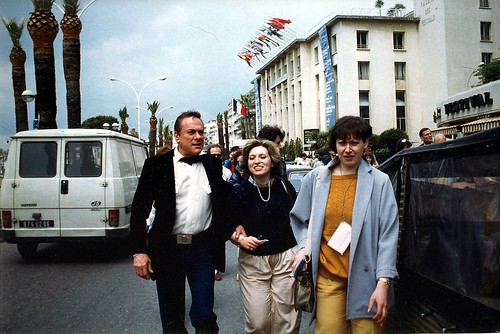
Tony Curtis & Anne-Elisabeth Moutet, Cannes Film Festival, 1985

France's film critics are the country's gift to world cinema. And at the Cannes Film Festival, they have their time in the spotlight, says Anne-Elisabeth Moutet.

8:17PM BST 13 May 2011

If it's May on the Riviera, it must be time for the Cannes Film Festival – and for another whine about how commercial everything has become. How could a festival meant to celebrate the art of cinema sell its soul to Hollywood's increasingly over-inflated blockbusters?

Rather than parading up and down the Croisette, getting photographed on the beach in skimpy bikinis, and generally doing the right thing by their fans, stars and jury members remain incarcerated in a soulless concrete bunker that looks and feels like the venue for a trade fair (which it is for the other 350 days of the year). Once inside, they're protected by a phalanx of press officers, a regiment of Navy Seals, and stricter retinal scans and background checks than for marrying into the Royal family.

Why do the French put up with it? Why demonstrate an entirely atypical flair for crass commerce by superimposing on to the main event – as well as elevated competitions like Semaine de la Critique – the Cannes Film Market, a roaring convention taking up the cavernous basement of the Palais des Festivals, where hawkers from around the globe will cheerfully sell you the rights to direct-to-video gems such as Combat Girls, Turn me on, Goddammit and The Godfathers of Ganja?

The answer is simple. Yes, Cannes might be a bit tasteless. But for the French, the whole affair still preserves the ultimate in filmic fiction: that it's our opinion that matters. Sure, we might not have been able to sell any of our television series between Inspector Gadget and Spiral. Sure, our last Oscar-winner may have been March of the Penguins. But by Guillaume, we're going to be the arbiters of cool in all things cinema. To that end, we happily bring the world's biggest stars to Cannes to run the gauntlet of a gang of critics wielding Derrida like a semi-automatic, and slather it in enough Gallic glamour to make Oscar night look like The Sarah-Jane Adventures.

There is none of that nonsense that afflicts the Oscars about voting by members of the Academy: the process of jury selection, as well as the ultimate choice of competing entries, is shrouded in opacity. Gilles Jacob, the president-for-life of the festival committee, has even, in Hosni Mubarak fashion, appointed his son to the four-person body that picks the 12 foreign entries in the Sélection Officielle from some 4,000 hopefuls.

The actual jury, picked with a canny eye for the best mix of star power and intellectual cred, changes every year. This time round, it includes Uma Thurman, Robert De Niro (as the chair), "Norwegian critic Linn Ullmann", as well as directors from France, China, Chad, an Argentinian "producer-actress", a Chinese producer, and Jude Law.

If this seems to be taking inclusiveness slightly too far, it is entirely intended. After the post-war years, when the French government supported the Festival as a way to rebuild the country's film industry, it gradually evolved into the magical meeting place of the movie world: Hollywood, Cinecittà, Ealing. And when François Truffaut deservedly snatched the Palme d'Or in 1959 for The 400 Blows, he and his fellow Cahiers du Cinéma critics turned Nouvelle Vague auteurs provided France with a cachet on which we have been trading ever since.

France has, admittedly, always been the best place in the world to see films. In those remote times before VHS, the 500-plus arthouses of Paris far exceeded in number and variety the choices available in New York, let alone the wastelands of London. After school, I picked up an invaluable crash course in the film culture of the past 70 years, ranging from Glauber Rocha to D W Griffith, from Billy Wilder to Antonioni, from John Ford to Karel Reisz, from Busby Berkeley to Ingmar Bergman.

And at the end of the day, the Cahiers crowd did make sense with their auteur theory, which maintains that a director is, in fact, the author of a unique work, not a hack standing behind the camera shouting directions. They were right about the distinctiveness of a film directed by Fritz Lang, Hitchcock, Ophüls, Carné or Visconti. (They also had a sort of point about Jerry Lewis – it was, in a way, unique in its sheer godawfulness.)

Perhaps, then, our critics, as much as our films, are our gift to world cinema. The history of the Nouvelle Vague is largely one of backseat drivers who turned filmmakers, with a sometimes astonishing degree of success. When a fanboy named Steven Spielberg cast Truffaut in Close Encounters of the Third Kind, he was acknowledging an intellectual ascendancy which the French have been careful to perpetuate.

It was we, too, who were the first to lionise Clint Eastwood as an auteur in the 1980s. The process was masterminded by a single, not particularly successful journalist, Pierre Rissient, who decided to remake this B-movie star into a cultural icon. (He also championed Quentin Tarantino, as well as Aki Kaurismäki, proof of his singular eye.)

So yes, we French can be infuriating. But every now and then, we get it right.

© Copyright Telegraph Media Group & Anne-Elisabeth Moutet 2011

Thursday, April 7, 2011

Sarkozy’s six wars will make or break him

The French president has public support, but if things go wrong that will fast disappear, says Anne-Elisabeth Moutet.

Libya: Sarkozy and Gadaffi before they fell out
Mr Sarkozy once enjoyed a cordial relationship with Col Gaddafi Photo: AFP/GETTY

Not even George W Bush could have hoped to get away with six simultaneous wars. Yet Nicolas Sarkozy seems to be thriving on them. We French have troops in Mali, Afghanistan, Burkina Faso, Somalia – and, most visibly, over Libya and in Ivory Coast.

Cynics will argue that Sarkozy is a gambler, staking his re-election next year on the throw of the military dice. But even though he’s wildly unpopular, and a political calculator nonpareil, the truth is that Sarko is also showing his own peculiar brand of sincerity. He genuinely believes, for instance, that France’s failure to stop the Rwandan genocide was dishonourable (as a junior minister, he argued in favour of intervention). And he has form: a couple of years ago, he authorised a raid against Somali pirates, resulting in the rescue of our hostages and the pirates being showily taken back to France for trial.

Any image of the French as pacifists is misleading. We hate losing wars, but we believe in both la gloire and in hard-nosed choices that we sell to ourselves as idealism. We have forgiven Sarko a botched (and fatal) attempt to free two hostages from an al Qaeda affiliate in Mali, and are remarkably quiet about our 10-year presence in Afghanistan. French troops have also been an almost constant presence in Ivory Coast over the past decade, more than once stepping in to prevent a Liberian-style civil war – and to protect French nationals and interests.

But what makes the current outbreak of muscular interventionism so delightful for Sarko is that he seemed to have missed his opportunity. When the Tunisian revolt began, the foreign secretary, Michèle Alliot-Marie, suggested that French police could help quell the unrest (for which she later lost her job). Events in Egypt, too, seemed to pass France by, not least because a host of presidents have been the grateful recipients of Hosni Mubarak’s hospitality: Sarkozy even went there to woo Carla Bruni in the winter of 2008.

What saved Sarko’s blushes was Col Gaddafi’s bloody repression of the Libyan revolt. This offered Sarkozy – and France – an overdue opportunity to take a principled stance. And the operation’s unlikely mastermind was one of France’s unique contributions to both fashion and global politics: Bernard-Henri Lévy, the battling philosopher with a line in human rights advocacy and designer shirts.

In February, the 62-year-old author of such slight but best-selling volumes as Barbarism with a Human Face (Communism: bad), Left in Dark Times (politically correct toleration of totalitarianism: very bad) and Who Killed Daniel Pearl? (LSE-graduate Islamists beheading US reporters: uniquely bad) found himself in Cairo. The situation was unbearable: he was but one of an indiscriminate mass of reporters, all after the same story. So when he heard the rumbles of revolt in Libya, he hitched a ride to Benghazi in a fruit-seller’s van, made his way to rebel HQ, told them he could arrange for them to get diplomatic recognition from France, borrowed an old satellite phone – and did just that.

Lévy sees himself as the reincarnation of André Malraux (Nobel-winning novelist, hero of the Spanish Civil War, wartime acolyte of de Gaulle and former culture minister). In truth, he is a far more buffoonish figure, but he certainly has connections: it was in his palazzo in Marrakesh that his daughter’s husband left her for Carla Bruni, and his godfather is the impeccably connected Gucci tycoon François Pinault. Although Lévy supported the socialists in the last election, and won’t vote for Sarko next year, the pair have dined together regularly for years. So, after he called Sarko, the president arranged for the rebel leaders to be spirited to Paris. The visit, and formal recognition of the rebels as the lawful government in exile, was kept so secret that the new foreign secretary, Alain Juppé, only heard about it when asked by reporters in Brussels.

So far, the gamble seems to have paid off. After France initiated the first air strikes against Gaddafi’s forces, the news was full of rebels waving tricolours and vowing that their firstborn would be named “Sarkozy”. Even warnings that some are former al‑Qaeda militants have failed to dent the popular support. As in Ivory Coast, French initiative is seen as preventing a bloodbath – and having a good conscience has always played well in Paris.

Of course, Sarko knows that things could turn sour at any moment. Loyalist counter-attacks mean that operations in Libya could last longer, and reports of massacres in Ivory Coast by supporters of the new president have cast a pall over events. All of which could transform what seemed clear-cut – supporting the good guys, preventing bloodshed, upholding France’s ideals – into a protracted, bloody mess. In Paris, as elsewhere, foreign adventures have often been the last resort of the battered politician. If the missions fail, Sarkozy’s presidency will surely fail with them.

© Copyright Telegraph Media Group & Anne-Elisabeth Moutet 2011

Monday, March 7, 2011

Fisticuffs with a French robber left me bruised but not beaten

Not everyone who opens their door in a quiet street off the Champs-Elysées is a little-old-lady pushover, says Anne-Elisabeth Moutet.

Fisticuffs with a French robber left me bruised but not beaten; The Champs-Elysées on a safer day; AP
The Champs-Elysées on a safer day Photo: AP

It took about five minutes to turn me into a Victim. I opened the door one afternoon to find a slim woman in biker leathers on my landing, perhaps two inches taller than my 5ft 3in. She said she had a package for me, and was carrying a cardboard box complete with a sheaf of documents.

The next thing I knew, I was shrieking blue murder while she repeatedly butted me with her full-face helmet. "Au secours! Au secours!" I bellowed while she tried to muzzle me, simultaneously punching me in the ribs and shoving me back into my flat.

My overriding feeling was of flabbergasted surprise, a sensation of nightmarish unreality mixed with fury that this cow thought she could get away with knocking me out and helping herself to my things. I knew I had to keep screaming – as for fighting back, that was sheer instinct.

I think it was mostly the noise that made her flee, and perhaps the unpleasant surprise that not everyone who opens their door in a quiet street off the Champs-Elysées is a little-old-lady pushover. Shaken and shaking, I got back inside and called the police, who duly showed up 20 minutes later. When I told them I was quite unscathed, they suggested I sit down, have "a little glass of something strong" (we are Parisian, after all) and wait for the adrenalin to ebb away.

Running a hand through my hair, I found half a dozen bumps. Meanwhile, my ribs started complaining, too. "Do you need an ambulance?" the flics asked. Surely I didn't. I made my way to the police station in a taxi, to file a formal complaint, and was told to report to the Médecine Judiciaire's Special Victims Unit at Hôpital de l'Hôtel-Dieu near Notre Dame, the only place officially mandated to assess the damage.

The strange thing was that at the unit, my injuries were treated almost as an afterthought (in fact, the doctor I saw missed a hairline crack in my eighth right rib, which was later caught by my private GP). What seemed to be everyone's overriding concern was the deep psychological damage that I had to be suffering. I was urged no fewer than four times by various people in white coats to go and receive counselling from the shrinks.

It was no use objecting that I was fine, really. "But I won the round!" I protested. I could see on their faces that this was only proof of how disturbed I was. "You can get compensation from the state," I was advised. Compensation for what? That nice Sécurité Sociale is already picking up my medical bills, nothing was stolen, and while my rib does hurt, especially at night, I can still bask in a mild sense of achievement at having driven off the invading horde of one.

...

The prize for the oddest French burglars must go to the team who recently robbed a funeral parlour in the small town of Valadon, making off with a couple of coffins, some cash and the village's only hearse. Even stranger, this is the fourth time the place has been burgled in as many years. It certainly gives the lie to "You can't take it with you."

...

The fiscal rigourists attacking Britain's high-speed rail link, such as the Telegraph's own Simon Heffer, have got it completely wrong. We French always knew that the TGV infrastructure would be loss-making. But economists calculated that the benefit to the economy at large was well worth the red ink on SNCF's balance sheet.

This is known as the externalities theory. SNCF did not directly profit from the development of former rust-belt cities such as Lille, or subsequent falls in the local crime rate, or the sharp increase in property prices along the tracks, or the added mobility in the workforce. But eventually, we all did. I suspect that British northerners, like the French ones, would rather find jobs in their region than come south. So give them trains.

© Copyright Telegraph Media Group & Anne-Elisabeth Moutet 2011

Sunday, March 6, 2011

Jacques Chirac's trial holds little fear for the ultimate bon vivant

Jacques Chirac's long-awaited corruption trial will begin in Paris this week. But, as Anne-Elisabeth Moutet writes, he can go to court on Tuesday with serenity.

CHIRAC
Jacques Chirac - Photo: GETTY

When Jacques Chirac finally shows up for his corruption trial, on Tuesday, in the Première Chambre Civile of the Paris Law Courts – the same where Queen Marie-Antoinette was once judged – he will sit on a special upholstered chair instead of the usual wooden bench in the dock.

There will be an extra lectern for the former French President's notes and documents, requested by his barristers; and a secured room within the historic Law Courts building will be made available to him to rest any time he "feels tired."

The court will already have sat for a full day; but Chirac, who is now aged 78 and in questionable health, has exceptionally been allowed to show up only on specific dates, the ones on which he is scheduled to be questioned by the judges.

Otherwise, we are asked to believe, the former president, now "a private citizen" after enjoying immunity from prosecution during his two consecutive terms from 1995 to 2007, will be tried like any other French politician accused of confusing official and party funds.

The case goes back to the early 1990s, when Chirac was Mayor of Paris.

On the city payroll were, it turned out, dozens of full-time employees who never did a stitch of work for the city. They were instead detailed to the right-wing RPR Gaullist party, there to help Mr Chirac's eventual, and successful, 1995 bid for the presidency.

The facts are not in dispute: other Chirac associates have already been sentenced for them, most notably former PM (and current Foreign Minister) Alain Juppé, who at the time was – conveniently – both Secretary General of the RPR and Paris Deputy Mayor for Finances.

Finally tried in 2004, Juppé was given a 12-month suspended jail sentence, and was declared ineligible for office for one year: he had to take a visiting professor's job in Canada for two years, before he could resume his political career.

The question is whether Chirac knew of his party's financial arrangements.

Although he denies it, he signed last year an out-of-court agreement with the capital's authorities whereby he and his party would refund them to the tune of €2.2 million. In exchange, the City relinquished its suit – to see it taken up by a group of Parisian taxpayers, outraged at what they see as a sweet deal for "less than half the true outlay".

As the case stands, Chirac, while theoretically facing up to 10 years in jail, a €150,000 fine and a five-year voting ban, wouldn't seem to be in really hot water.

For one thing, the state prosecution office – which operates under the direct authority of the justice ministry – has already said it was pushing for a dismissal, "because there isn't enough proof."

Only cynics, perhaps, will observe that we stand barely a year from the next presidential election, and Nicolas Sarkozy will need the entirety of the Gaullist party, nostalgic Chiraquiens and all, squarely behind him in what will be a tight race.

For another, the 6'3" beer-drinking, calf's head scoffing, larger-than-life bon vivant the French always had a soft spot for is suddenly rumoured to be "frail", "ailing", and suffering from Alzheimer's – rumours which Chirac and his high-profile wife, Bernadette, have carefully denied in targeted public statements. (That's officially what the special chair and lectern and side room near the courthouse are all about.)

This should be enough to ensure, in the worst-case scenario, a suspended sentence.

Never mind that only two weeks ago Chirac couldn't bear to miss the Paris yearly Agricultural Show, which he has faithfully visited on opening day for the past four decades, whether in office or out.

There he was mobbed by the crowds, basking in the admiration and love of tens of thousands of his favourite constituents, French farmers, who feel nobody has or will ever fight their corner as fiercely again. Nicolas Sarkozy is usually booed at the Salon de l'Agriculture.

It is ironic that the trial should take place barely one week after one of Chirac's protégés, Michèle Alliot-Marie, was sacked from her job as foreign minister merely for having accepted free flights from a relative of Tunisia's just-deposed strongman, Zine el-Abidine Ben Ali. (It is even more amusing that she should be replaced by none other than Alain Juppé, who at the time of his sentencing, for the same facts Jacques Chirac is now being tried for, was said to be bitter at having to carry the can for persons unnamed.)

In the last a couple of years, the climate in France has become starkly intolerant of corruption, extra perks, dodgy political financing and the like.

The public used not bat an eyelid at secret second families housed and guarded at the Republic's expense (François Mitterrand's), lavish holidays paid by exotic tycoons in five-star palaces (Mitterrand, Chirac), gifts of diamonds by megalomaniac African tyrants (Valéry Giscard d'Estaing), secret state funds re-routed to political campaigns (everyone's, even staid, Calvinist Socialist PM Lionel Jospin), not to mention a comfortable blurring of the private and public use of what must surely be the loveliest official real estate in the world, all the aristocratic palaces of France's nobility, complete with their furniture and artworks, turned into ministerial offices and grace-and-favour homes.

No longer.

A combination of the economic crisis, Nicolas Sarkozy's perceived love of bling, and the globalisation of political sensitivities has made French politicians' life less comfortable of late.

One minister was recently sacked because he charged his office for €12,000 worth of Cuban cigars. (And he had to pay for the cigars.)

Another was a victim of an early reshuffle because she'd lent her grace-and-favour flat to her unemployed brother for one month. Yet another lost his job after favouring private planes over scheduled flights.

Besides the ousting of various strongmen, the Arab spring claims as collateral damage the reputation of a number of French politicos, as week after week their holidays with this or that tyrant are being made public.

What is perhaps surprising is the Teflon-like popularity of Jacques Chirac even today.

The French are largely aware that in or out of office, Chirac never paid for a luxury holiday in his life (in Morocco, in Oman, at the luxurious Hôtel du Cap-Eden Roc on the Riviera, as guest of the luxury tycoon and Gucci owner François Pinault in his St Tropez compound.)

They know Chirac was proven to have spent some €4,000 a day in "entertaining and food expenses" when he was Paris Mayor. They know the Chiracs have been living rent-free since they left the Elysée palace in 2007 in a luxurious 4,300 square foot Paris flat on the Seine, 3 Quai Voltaire, just opposite the Louvre, "loaned" by the family of Lebanon's slain PM, Rafik Hariri. But apparently, they don't care.

However strange it may seen, Chirac, who is the scion of a provincial industrialist, married to the aristocratic daughter of an early De Gaulle supporter, and whose constituency home is a 17th century château he had listed in the early 70s to make its maintenance tax-deductible, is seen as having the common touch, being one of the people.

His second term as president was marked by strikes and rising unpopularity, but now that Nicolas Sarkozy's poll numbers have sunk even lower than his ever did, he is considered fondly by Right and Left alike.

The former regret his more consensual style. The latter give him credit for opposing the Iraq war from the start.

All things considered, he can go to court on Tuesday with serenity – nothing, not even a judicial rap on the fingers, can seemingly change his reputation.

© Copyright Telegraph Media Group & Anne-Elisabeth Moutet 2011